

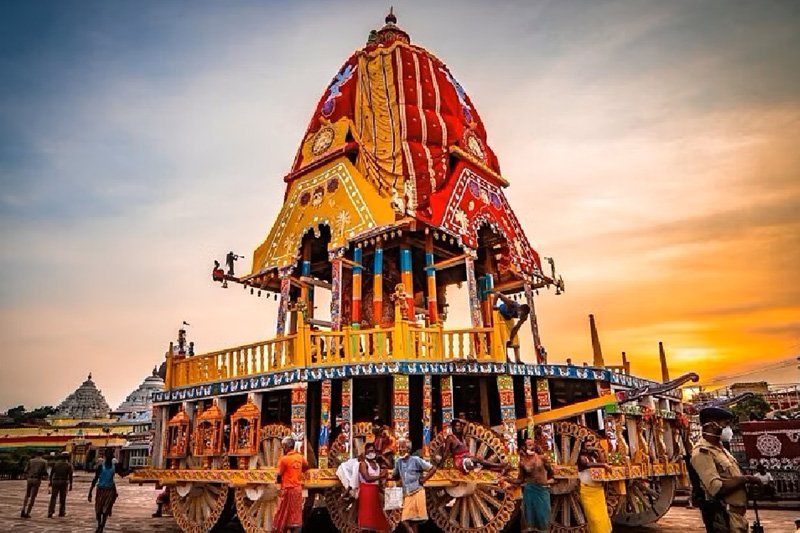

Rath Yatra, also known as the Chariot Festival, is one of the most significant and widely celebrated festivals in Puri, Odisha, India. It is dedicated to Lord Jagannath, his brother Lord Balabhadra, and their sister Devi Subhadra.
The Rath Yatra festival involves the procession of the deities of Lord Jagannath, Lord Balabhadra, and Devi Subhadra in elaborately decorated chariots. The main chariot, called Nandighosa, is for Lord Jagannath and is the largest among the three. The chariot of Lord Balabhadra is called Taladhwaja, and the chariot of Devi Subhadra is known as Darpadalana.
The Rath Yatra takes place on the second day of the bright fortnight of the Hindu month of Ashadha, which usually falls in June or July. The festival begins with a ceremonial ritual called Snana Purnima, where the deities are bathed and undergo a period of rest and recovery known as Anasara.
On the day of the Rath Yatra, the deities are taken out of the Jagannath Temple and placed on the chariots. Thousands of devotees gather to witness and participate in pulling the chariots through the streets of Puri. The chariots are pulled using long ropes by enthusiastic devotees, and it is considered extremely auspicious to have the opportunity to touch the ropes or the chariots.
The procession covers a distance of about three kilometers from the Jagannath Temple to the Gundicha Temple, also known as the Mausi Maa Temple, where the deities stay for nine days. Devotees flock to seek darshan (divine glimpse) of the deities during this time.
The Rath Yatra is not only celebrated in Puri but also in many other parts of India and around the world by devotees of Lord Jagannath. It is a time of immense joy, devotion, and celebration, with music, dance, and various cultural performances being a part of the festivities. The festival is considered a symbol of unity, equality, and devotion to Lord Jagannath, who is believed to be the Lord of the Universe.

0 Comment